 Travel
Blog
Semana santa Seville province 2026
Semana Santa Seville 2026 Semana Santa Seville 2026 Calendar Brotherhoods Towns Gastronomy Tips Seville · 2026 Semana SantaSevilla Experience the sacred brotherhoods, golden pasos, and spiritual depth of Holy Week in the heart of Andalusia Explore Calendar Discover Brotherhoods Holy Week Calendar March 29 – April 5, 2026. Discover the key processions and brotherhoods of…
Seville · 2026
Semana Santa
Semana Santa
Sevilla
Experience the sacred brotherhoods, golden pasos, and spiritual depth of Holy Week in the heart of Andalusia
Holy Week Calendar
March 29 – April 5, 2026. Discover the key processions and brotherhoods of Seville’s Semana Santa.
March 29
Palm Sunday
La Borriquita · La Paz
The procession of the children — Jesus entering Jerusalem on a donkey. The streets fill with palm branches and jubilant crowds.
🌴
March 30
Holy Monday
El Silencio · El Gran Poder
El Silencio walks in complete darkness at midnight, while El Gran Poder — the most revered paso in Seville — processes at dawn.
🕯️
March 31
Holy Tuesday
La Macarena · La Esperanza
La Macarena is arguably the most famous Virgin in all of Spain. Her tears of crystalline glass and embroidered mantle are legendary.
👑
April 1
Holy Wednesday
Jesús del Gran Poder · La Trinidad
One of the most emotionally charged nights, with pasos processing through the narrow streets of the historic Triana neighbourhood.
🔥
April 2
Maundy Thursday
La Expiración · El Museo
Thursday night into Friday morning — the “Madrugá” — is the holiest and most moving night of Holy Week. Multiple cofradías process until dawn.
🎖️
April 3
Good Friday
La Soledad · Santo Entierro
The most solemn day. The Santo Entierro (Holy Burial) procession moves in profound silence through streets lined with candles.
⚰️
April 5
Easter Sunday
La Resurrección
The joyful conclusion — the only procession to walk at sunrise. Bells ring across the city as Seville celebrates the Resurrection.
✨
The Brotherhoods
Seville’s 57 cofradías carry centuries of tradition. Each brotherhood has its own history, colours, and devotional image that define its identity.
Holy Monday · Dawn
El Gran Poder
Jesús del Gran Poder
The most venerated image of Christ in Seville, sculpted by Juan de Mesa in 1620. His procession at dawn on Holy Monday draws tens of thousands who wait through the night to see him pass.
Founded1431
Pasos2
Nazarenos2,400
Holy Tuesday · Night
La Macarena
Nuestra Señora de la Esperanza Macarena
Crowned with five royal diadems and dressed in an embroidered mantle worth millions, La Macarena’s passage through her barrio stops hearts. Her crystalline tears are among the most iconic images of all Semana Santa.
Founded1595
Pasos2
Nazarenos2,700
Holy Tuesday · Night
La Trianera
Nuestra Señora de la Esperanza de Triana
The beloved Virgin of Triana — Seville’s ancient gypsy quarter. Her paso crosses the Guadalquivir river on the Puente de Triana to enter the city in one of the most dramatic and emotional moments of Holy Week.
Founded1418
Pasos2
Nazarenos2,100
Maundy Thursday · Madrugá
El Silencio
Nuestro Padre Jesús Nazareno
Processing in absolute darkness and silence since 1340, El Silencio is the oldest cofradía in Seville. No music — only the sound of bare feet on cobblestones and distant saetas sung from balconies above.
Founded1340
Pasos2
Nazarenos2,200
Understanding the Traditions
The Pasos
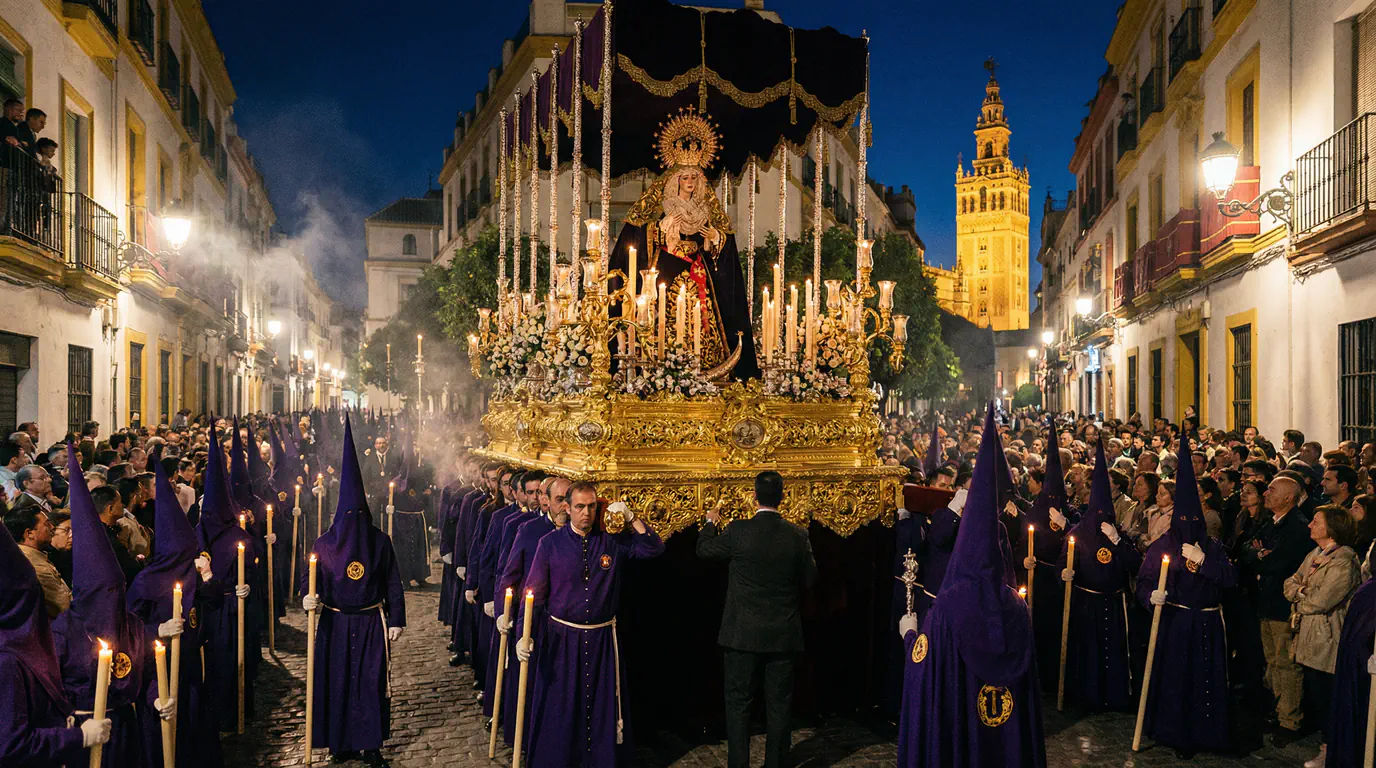
Massive ornate floats — some weighing several tonnes — carrying sculpted images of Christ and the Virgin. Carried on the shoulders of up to 40 costaleros (bearers) hidden beneath.
The Cofradías
Religious brotherhoods that organise and lead each procession. Members process as nazarenos — wearing the distinctive pointed capirote hoods — as an act of penance and devotion.
The Saetas
Flamenco-style devotional songs sung spontaneously from balconies as a paso passes beneath. Raw, unaccompanied, and deeply moving — they bring processions to a standstill.
The Madrugá
The magical night from Holy Thursday into Good Friday. Six of the most beloved cofradías process through the night. The most intense and emotional experience of all Holy Week.
Towns & Traditions
Beyond Seville city, the province offers unique local traditions and breathtaking settings for Holy Week celebrations.
Inland Seville
🏔️ Carmona
Local TraditionProcessional Silence
One of the oldest towns in Europe, Carmona’s processional routes wind through Roman-era streets. The Brotherhood of El Señor del Soberano Dolor is particularly revered.
Sierra Norte
🏞️ Cazalla de la Sierra
Local TraditionMountain Processions
The dramatic hillside setting gives Cazalla’s processions an otherworldly quality as candlelit pasos wind through cobblestone alleys between whitewashed houses.
Coastal Seville
⛪ Utrera
Local TraditionFlamenco Roots
Utrera’s deep connection to flamenco makes its Semana Santa uniquely musical. The saetas sung here are considered among the purest and most authentic in all Andalusia.
Eastern Province
🎭 Écija
Local TraditionCity of Towers
Known as the “City of Towers,” Écija’s Baroque bell towers create a stunning backdrop. The processions here blend Sevillian tradition with local customs unique to this historic city.
Pro Tip
Visit multiple towns during Holy Week to experience the diversity of Sevillian traditions. Each location offers a unique perspective on Semana Santa — smaller towns are far less crowded and often more intimate.
Culinary Traditions
The flavours of Holy Week — traditional dishes tied to religious fasting and celebration that have been passed down for generations.
🍞
Torrijas
Bread soaked in milk, dipped in egg, fried and drizzled with honey or cinnamon sugar. Seville’s beloved Easter treat, found in every bakery from Palm Sunday onwards.
🐟
Bacalao al Ajo Arriero
Salt cod with garlic, tomatoes and peppers. A centuries-old Lenten staple — meat was forbidden during Holy Week, so salt cod became the centrepiece of the Sevillian table.
🍲
Potaje de Garbanzos
A hearty chickpea and spinach stew with salt cod, cooked slowly with cumin, paprika and garlic. The definitive Semana Santa dish in every Sevillian home.
🍪
Pestiños
Deep-fried dough rings glazed with honey and anise, dusted with sesame seeds. These delicate Moorish-origin pastries perfume the air around every market stall during Holy Week.
Visitor Planning Guide
Essential advice for experiencing Semana Santa 2026 in Seville — from where to stand to what to wear.
01
Book Months in Advance
Hotels in central Seville sell out a year ahead for Semana Santa. The closer to the Cathedral and La Macarena barrio, the better. Book now — prices triple during Holy Week.
02
Know the Carrera Oficial
The official route runs through Plaza de San Francisco and past the Cathedral. Seating here is ticketed and reserved. Watch for free at the beginning or end of the route.
03
Stay for the Madrugá
The night of Holy Thursday into Good Friday is unmissable. Six cofradías process through the night — El Gran Poder and La Macarena chief among them. Join the crowds from midnight.
04
Dress Respectfully
This is a deeply religious event, not a festival. Dress modestly, keep voices low during solemn moments, and never walk between a paso and its band.
What to Bring
- Comfortable walking shoes
- Light layers (spring evenings cool quickly)
- Portable charger
- Cash (street vendors don’t take cards)
- Small backpack
- Earplugs (for long waits)
- Water bottle
- A programme guide (buy on arrival)
Silence During Pasos
When a paso passes, lower your voice. Many people are moved to tears. Loud talking is considered deeply disrespectful.
Photography
Photography is permitted but use judgment. Flash disturbs the atmosphere — and the costaleros carrying tonnes of float.
Dress Code
Modest dress is expected. Avoid shorts and sleeveless tops near the procession routes, particularly near churches.
Participation
You are always welcome to observe. Join the saeta singers in applause at the end — this is how Seville shows devotion.
✦ ✦ ✦
Semana Santa in Seville is the soul of Andalusia made visible.
Whether drawn by faith, art, music, or simply the spectacle — Holy Week 2026 will leave a mark that lasts a lifetime.