 Travel
Travel
The Perfect Andalucia 7-Day Itinerary (2026 Guide)
The ideal 7-day Andalucia itinerary for first-timers — Seville, Córdoba, Granada, Ronda, and Málaga — with day-by-day plans, costs, and a no-car version.
This Andalucia 7-day itinerary is designed for first-time visitors who want the essential highlights of southern Spain — the great cities, a white village or two, and the coast — done in a week.
Andalucia 7-Day Itinerary: Key Planning Points
Seven days in Andalucia is the sweet spot. Long enough to fall properly under the spell of Seville’s flamenco-soaked evenings, the Alhambra’s impossible filigree, and the cliff-edge drama of Ronda — short enough that you don’t need to take a sabbatical from real life. This itinerary moves you across the region’s three legendary cities, lets you breathe in a Pueblo Blanco or two, and ends with a coast day in Málaga before you fly home.
This andalucia 7-day itinerary guide covers everything you need to know for your trip.
Use this andalucia 7-day itinerary resource to plan each stage of your visit to Andalucia.
I’ve written this for first-time visitors who want the highlights done well rather than a frantic checklist. You’ll get the route, the day-by-day plan, the realistic costs, and — importantly — a no-car variation if driving in Spain isn’t your idea of a holiday.
What this 7-day Andalucia itinerary covers
Route map
The route is a clean loop through the historic heart of Andalucia: Seville → Córdoba (day trip) → Granada → Ronda → Málaga. You start and end at airports with strong international connections (Seville SVQ or Málaga AGP), which keeps flight costs sensible.
Total drive time across the week: about 9 hours, broken into bite-sized 1.5–3-hour legs — never a slog. By train it’s similar in actual journey time but you skip the parking dramas.
Who this is for
This itinerary suits you if:
- It’s your first trip to Andalucia and you want the iconic sights plus a taste of the real region (white villages, tapas, mountain towns).
- You’re travelling as a couple, solo, or with older kids — the pace is brisk but not punishing.
- You want a balanced mix of cities, culture, and a bit of countryside.
- You’re happy with early starts on at least three days (Alhambra slots, summer heat).
If you’re travelling with very young children, want pure beach time, or are interested in deep hiking — this isn’t the right plan. We’ll point you to better fits at the end.
How to use this guide
Skim the day-by-day sections first to picture the rhythm of the trip, then go deep on transport, packing, and budget. Every day has a morning, afternoon, and evening structure with one insider tip — the kind of thing you only learn after a few visits.
When to plan your Andalucia road trip
Spring (April – June): the gold-standard window
This is when Andalucia is at its most magical. Daytime temperatures sit between 18°C and 28°C — warm enough for terraces and rooftop bars, cool enough that the Alhambra’s stone courtyards stay comfortable past noon. Wildflowers carpet the Sierra de Grazalema in April and May. The patios of Córdoba burst into bloom for the Fiesta de los Patios (first two weeks of May), one of the region’s most underrated experiences.
Heads-up: Semana Santa (Holy Week, late March or early April) and the Feria de Abril in Seville (two weeks after Easter) double accommodation prices and pack the cities. Magical to witness, expensive and crowded to navigate. Either lean in (book 6+ months ahead) or pick a quieter week.
Autumn (September – October): the underrated runner-up
September starts hot and softens through the month. By early October, you get spring-like temperatures, much smaller crowds, and harvest-season menus. Olive harvest in Jaén, sherry harvest in Cádiz province. Mid-October is my personal pick if you can swing it — empty Alhambra slots, warm-but-not-fierce weather, and the most affordable hotel rates of the year.
Why to avoid summer (July – August)
Daytime highs of 38°C–44°C in Seville and Córdoba are common. Cathedrals and historic centres become hostile in the afternoon, locals sensibly retreat for siesta, and you’ll spend more on cold drinks and air conditioning than on actual sightseeing. If summer is your only window, swap Córdoba for a coastal day in Cádiz and treat sightseeing as a 7am–11am activity. Otherwise, push the trip to spring or autumn.
Special events to time your visit around
- Feria de Caballo — Jerez, May. A horse-and-sherry spectacle.
- Bienal de Flamenco — Seville, September (every other year). The world’s biggest flamenco festival.
- Romería del Rocío — Pentecost weekend, near Almonte. A Pilgrimage with hundreds of thousands of participants.
How to get around: car, train, or both
Renting a car
A car gives you access to the white villages, Setenil de las Bodegas, and the dramatic Caminito del Rey hike near El Chorro — places trains simply don’t reach. Expect €220–€350 per week for a small economy car, plus around €60 in fuel and €5–€10/day in parking when you’re in the cities.
Practical tips that will save your trip:
- Reserve a hotel with parking included or use Parking Paseo de Cristina in Seville (€20/day, central, secure) — street parking in Andalusian historic centres is often a no-go zone for non-residents.
- Hotels often quote rates without parking — check before booking.
- All major rentals require a credit card in the driver’s name with €1,000+ available limit for the deposit.
- Watch for ZBE (low-emission zone) signs in Seville, Granada, and Málaga centres. Foreign plates without registration get fined automatically.
Travelling by train
Renfe’s high-speed network connects all the big stops. Approximate journey times:
- Seville → Córdoba: 45 min, from €25
- Córdoba → Granada: 1h 30 min, from €30
- Granada → Málaga: 1h 25 min, from €25 (via Antequera)
Book directly at renfe.com for the best fares — the cheapest “Básico” tickets are often half the price of those sold via third-party aggregators. Buy at least 3 weeks out to lock those in.
Combining both
The smartest play for many travellers: trains for the city legs, a one-day rental for Ronda and the white villages. Rent in Granada or Málaga for €40–€60 for the day, return to the same airport, never deal with city parking.
What I recommend
For first-time visitors who want to see the Alhambra, the white villages, and keep things easy: train Seville → Córdoba → Granada, then a 2-day rental from Granada through Ronda to Málaga. You skip city parking, get the white-village access, and end with the car ready to drop at Málaga airport.
Days 1–3: Seville and Córdoba
Day 1 — Seville arrival
Land at Seville (SVQ) by mid-morning if possible. Drop bags, grab a strong café cortado at Bar Alfalfa in the Alfalfa district, and spend the afternoon getting your bearings on foot. Don’t try to see anything major today — Seville’s centre is a walkable lattice of plazas and tile-lined alleys, and the wandering itself is the point.
In the evening: tapas crawl through Triana across the river. Three-stop minimum. Bar Las Golondrinas (the bull-themed one) for old-school staples, Casa Cuesta for paella, Manolo Cateca for the ambient drink afterwards.
Insider tip: Seville sleeps late. Restaurants don’t fill until 9.30pm. If you eat at 7pm you’ll be alone with the tourists; eat at 9.30pm and you’re with the locals.
Day 2 — Seville sightseeing
This is your big city day. Book your Alcázar entry for 9.30am (online, in advance — arriving without a ticket means standing in line for 90 minutes). Two hours inside is the sweet spot. After lunch, climb La Giralda at the cathedral (it’s a ramp, not stairs — anyone can do it), then wander the Barrio Santa Cruz before its 5pm tourist peak.
Late afternoon: catch a flamenco performance at Casa de la Memoria (small, intimate, intensely authentic — €22, book ahead). Reserve dinner at El Rinconcillo for after — it’s been continuously open since 1670.
Insider tip: Seville Cathedral and the Alcázar are next door to each other but operate on completely separate ticket systems and queues. Buy both tickets online the night before with an hour’s gap between entry slots.
Day 3 — Day trip to Córdoba
Catch the 8.30am AVE to Córdoba (45 min). Walk straight to the Mezquita-Catedral for an early entry — the forest of red-and-white double arches is one of the most extraordinary architectural experiences in Europe, and you want it as quiet as possible.
After the Mezquita, lose yourself in the Judería (old Jewish quarter). If you’re here in May, the Patios festival is on — homeowners open their flower-filled courtyards to the public, free, until early evening. Lunch at Casa Pepe de la Judería for salmorejo (cold tomato soup, Córdoba’s specialty) and flamenquín.
Late train back to Seville. You’ll be home by 7.30pm with time for a final tapa near your hotel.
Insider tip: Mezquita is free for the first hour after opening Mon–Sat. Show up at 8.30am for free entry, then explore the Judería at full daylight after.
Days 4–5: Granada and the Alhambra
Day 4 — Granada arrival
Morning AVE from Seville (via Antequera, ~3h with the change). Arrive in Granada by lunchtime, drop bags in the Albaicín (the old Moorish quarter on the hill opposite the Alhambra). Lunch on the rooftop terrace of Carmen Mirador de Aixa — your first view across to the Alhambra, slightly surreal.
Spend the afternoon wandering the Albaicín’s stepped lanes. Catch sunset at Mirador de San Nicolás — it’s a tourist magnet but it’s a tourist magnet for a reason: the Alhambra glowing gold against the Sierra Nevada is one of those moments worth standing in a crowd for. Dinner at Bar Aliatar afterward, a proper Granada tapa-libre spot where every drink comes with a free tapa (yes, really).
Insider tip: The walk up to San Nicolás is steep and cobbled. Wear flat shoes and start 75 minutes before sunset to claim a spot near the wall.
Day 5 — Alhambra and Albaicín
The Alhambra is the headline of this trip. Book your Nasrid Palaces slot the moment you commit to the dates — they sell out 2–3 months ahead in spring and autumn, sometimes a full year out for peak season. The official site (tickets.alhambra-patronato.es) is the only one that gives you face-value pricing.
A morning slot (8.30am or 9am) gives you the gardens at their cool best and the palaces before tour groups arrive. Allow 3.5 hours minimum inside — Generalife gardens, Alcazaba fortress, Nasrid Palaces, and the Carlos V palace courtyard. Bring water; almost no shade in summer.
Afternoon: descend to the Sacromonte caves (10-min walk from the Alhambra) for either a coffee with a view or a flamenco zambra performance at Cueva los Tarantos (book early evening slot).
Insider tip: Your Nasrid Palaces ticket has a 30-minute entry window written on it. If you miss it, you don’t get in. Set a phone alarm for 20 minutes before your slot.
Days 6–7: Ronda, white villages, Málaga
Day 6 — Ronda and Setenil
Pick up your rental car in Granada early morning. The drive to Ronda is 2h 45min through dramatic mountain scenery — leave by 8am to arrive for late lunch.
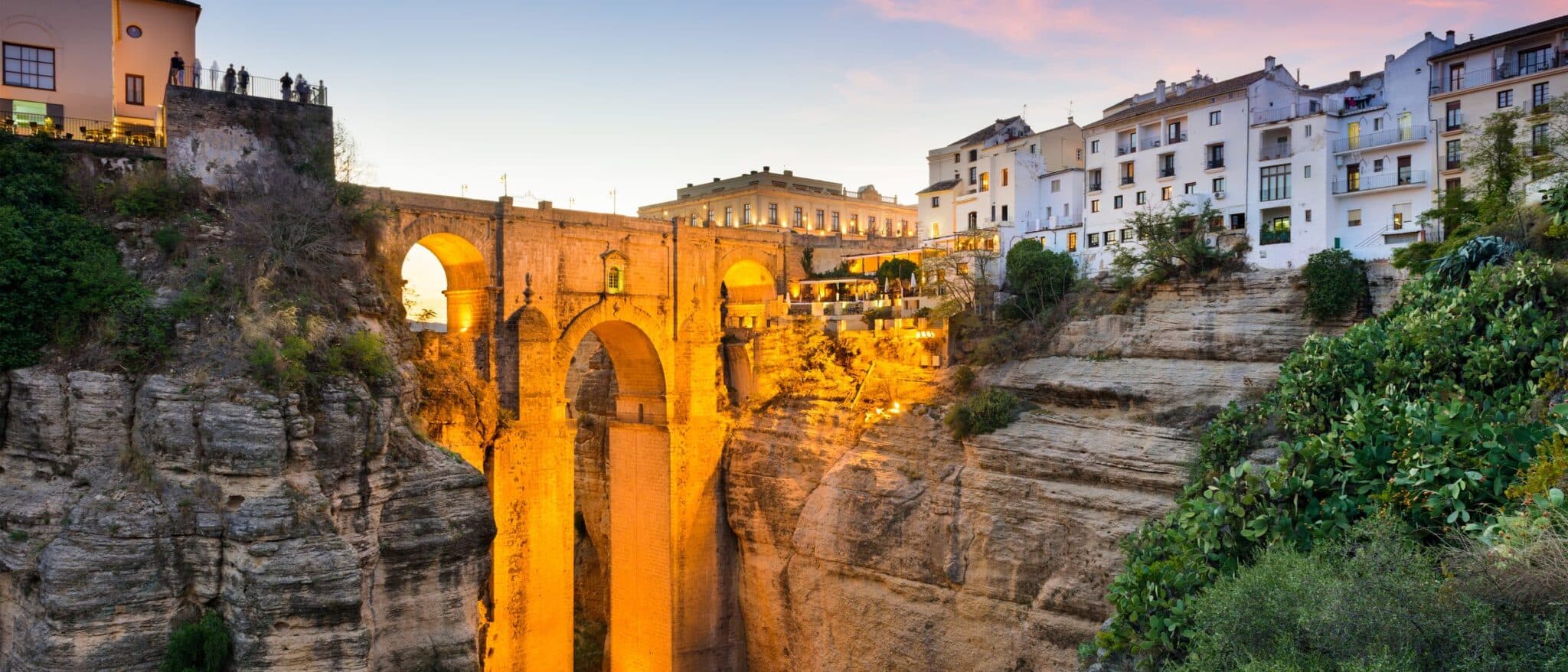
Ronda itself is built across a 100-metre gorge, spanned by the 18th-century Puente Nuevo. Walk both sides of the bridge (the views from below, via the Camino de los Molinos trail, are arguably better than from on top). Visit the Plaza de Toros (Spain’s oldest active bullring), even if bullfighting isn’t your thing — the architecture is remarkable.
Late afternoon: 20-min drive to Setenil de las Bodegas, the village where houses are literally built into and under massive overhanging rocks. Watch sunset from Bar Frasquito with a glass of local wine.
Sleep in Ronda — the town is at its best after the day-trippers leave.
Insider tip: Ronda’s parking situation is notoriously tight. Book a hotel that includes parking, or use the underground Parking Plaza Socorro (€18/day, 5-min walk to everything).
Day 7 — Málaga and departure
Drive Ronda → Málaga (1h 45min). Drop the car at the airport rental return, taxi or train into the centre.
Málaga is a deceptively underrated city. If you have a full day, the Picasso Museum (he was born here), the Alcazaba (a smaller-but-charming Moorish fortress), and Atarazanas Market for lunch are all worth the time. If your flight is afternoon, just walk the seafront at Playa de la Malagueta and have lunch at one of the chiringuitos (beach restaurants) for grilled sardines on a stick — espetos, the city’s defining dish.
Insider tip: Málaga’s old town is fully walkable from the train station. Don’t bother with a taxi unless you have heavy luggage.
Itinerary variations
Without a car (★ the no-driving version)
This route works almost entirely by train — the only sacrifice is Ronda and the white villages. Two options:
- Skip Ronda entirely. Train Granada → Málaga directly (1h 25min). Spend the saved day on Málaga itself or a day trip to Nerja (1h east, accessible by bus, gorgeous beaches and caves).
- Take a guided day tour from Seville to Ronda. Get-Your-Guide and Civitatis offer well-rated full-day tours (€55–€85) that include white-village stops. Less freedom, zero hassle.
With kids
Drop Day 3 (Córdoba) — the Mezquita is wasted on under-10s. Add an extra night in Granada and visit the Parque de las Ciencias (interactive science museum, easily a half-day). Skip the Sacromonte flamenco; the Cueva del Gato swimming hole near Ronda is a much better afternoon for kids.
Slow-travel 10+ days
Add Cádiz (2 nights between Seville and Granada — beach + Roman ruins + the best fish in Andalucia) and Almería (1-2 nights for desert landscapes and the Cabo de Gata coast). The relaxed pace transforms the whole trip.
Reverse direction
Fly into Málaga, out of Seville. Identical itinerary in reverse. Useful if Málaga flights are cheaper from your origin city, or if you want to peak with Seville rather than wind down with Málaga.
What to pack for Andalucia
Spring/autumn essentials
- Layers. Mornings are cool (12–15°C), afternoons warm (24–28°C). A light fleece or sweater you can stuff in a daypack.
- Walking shoes broken in. You’ll do 15,000+ steps per day on cobblestones.
- A small daypack for water, sunscreen, and Alhambra ticket.
- A scarf or pashmina — useful for cool evenings and for covering shoulders if you visit the cathedrals.
Summer essentials
- Lightweight, light-coloured clothing. Linen if you have it.
- Sun hat with a brim — not a cap, a brim.
- Reusable water bottle. Public fountains are everywhere and the water is excellent.
- Electrolyte sachets. Daytime heat genuinely dehydrates you faster than you realise.
What to leave behind
- Dressy clothes — Andalucia is informal everywhere except the Michelin-starred restaurants.
- A heavy hairdryer — every hotel has one.
- US plug adapters with three pins — Spain is type C/F (two round pins).
Costs and budget breakdown
Mid-range estimate per person (excluding flights)
For a couple sharing a hotel room, in spring shoulder season:
| Category | 7-day total per person |
|---|---|
| Accommodation (mid-range, 3-star) | €420 |
| Trains + 2-day car rental + parking | €180 |
| Food (1 nice dinner/day, casual lunches) | €240 |
| Attractions (Alhambra, Alcázar, Mezquita, flamenco) | €110 |
| Coffee, water, tapas, miscellaneous | €100 |
| Total | ~€1,050 |
Solo travellers add roughly €120 (single-supplement on hotels). Backpacker-tier with hostels and street food: €550. Comfort-tier with 4-star hotels and a pre-booked driver: €1,800.
Budget tips
- Eat your main meal at lunch. Many restaurants offer a menú del día (3 courses + drink) for €13–€18 — the same kitchen at half the dinner price.
- Tapas-hop instead of sitting down. Standing at the bar is always cheaper than table service and far more authentic.
- Free Mezquita hours. Mon–Sat, 8.30am–9.30am, no charge.
- Free Alcázar entry. Last hour on Mondays (April–Sept) or last hour on certain other days — check the official site.
Where to splurge
If you only splurge on one thing: a quality hotel in Granada with an Alhambra view. Options like Hotel Casa 1800 Granada or the Parador de Granada (inside the Alhambra grounds itself) are worth every euro for one night.
Where to stay: best areas in each city
Seville neighbourhoods
- Santa Cruz / Cathedral area. Most photogenic, walkable to everything. Slightly touristy but lovely.
- Triana. Across the river. Real-Sevilla vibe, excellent tapas, 15-min walk to the cathedral.
- Alfalfa / Encarnación. Best food scene, lively at night.
Granada neighbourhoods
- Albaicín. Steep, cobbled, Moorish character. The Alhambra views.
- Realejo. Old Jewish quarter, slightly less steep, great tapas streets.
- City centre near the Cathedral. Convenient if you don’t want to climb hills.
Málaga neighbourhoods
- Soho / Centro Histórico. Walkable, full of restaurants, near everything.
- La Malagueta. Right on the beach, modern, great for one beach-day.
Key takeaways
- Seven days covers Seville, Córdoba, Granada, Ronda, and Málaga at a sensible pace.
- Spring (April–June) and October are the gold-standard travel windows.
- Train it for the cities, rent a car for 2 days for the white villages.
- Book the Alhambra Nasrid Palaces 2-3 months ahead — it’s the one bottleneck of the entire trip.
- Eat at 9.30pm to be with the locals, not the tourists.
- Budget €1,000–€1,200 per person for a comfortable mid-range trip excluding flights.
Plan your trip
This 7-day route is the foundation — once you know it, you can stretch it (10 days adds Cádiz brilliantly), shrink it (5 days = drop Ronda), or remix it for repeat visits. Ready for the next layer?
- For the Alhambra deep-dive: read our full Alhambra Visitors Guide.
- For the no-car version: read our Andalucia Without a Car itinerary.
- For shoulder-season planning: see our Best Time to Visit Andalucia guide.
Spain rewards the patient traveller. Pace yourself, eat late, drink the local wine, and let Andalucia do its thing.
Useful Resources
For official travel information, visit Andalucia on Spain Tourism. For train bookings, visit Renfe official site.
More from this site: Best time to visit Andalucia | Renting a car in Andalucia.
First trip to Andalucía? Start with the first-timer’s guide — it covers the decisions this route assumes you have already made.
Frequently asked questions
Is 7 days enough for Andalucia?
For first-time visitors hitting the highlights — yes, comfortably. You’ll see the three big cities, a white village, and get a taste of the coast. To go deep into any region or add Cádiz/Almería, you’ll want 10–14 days.
Can I do this itinerary without driving?
Yes — most of it. Trains cover Seville → Córdoba → Granada → Málaga easily. The only thing you’ll miss is Ronda and the white villages, which are car or guided-tour only. See the “Without a car” variation above.
What about Cádiz, Jerez, and Almería?
All wonderful, none essential for a first-time 7-day trip. Add them on your second visit (and you will visit again — Andalucia hooks people).
Is Andalucia safe?
Extremely. The cities have low violent crime; the main thing to watch for is pickpocketing in tourist hotspots (Cathedral steps in Seville, Albaicín in Granada). Use a crossbody bag, keep your phone out of your back pocket, and you’ll be fine.
How far in advance should I book the Alhambra?
For spring (April–June) and autumn (October): 2–3 months minimum. For summer or Easter week: 6–12 months. Last-minute tickets occasionally appear at 8am the day before — set an alarm and refresh.