 Travel
Travel
September in Almería: the month Cabo de Gata gives itself back
In July and August the best beaches in the province are capped, permitted and shuttle-only. By mid-September the restrictions ease and the sea is still at its warmest.
Almería is the driest province in Spain and the one that notices September least. Highs go from about 29°C on the 1st to 26°C on the 30th — the gentlest decline of the eight provinces. The sea sits at 22.5–23°C, the warmest water in Andalucía, and stays swimmable well into October.
What actually changes here is not the weather. It is access.
What the weather actually does
Almería airport averages 28.4°C by day and 20.0°C at night in September, with 14mm of rain. The chance of a wet day runs from 2% to 7% across the month.
Those 14mm make Almería the driest of the eight Andalusian capitals in September. Put that next to a sea holding 22.5–23°C and you get what nowhere else in the region offers: reliable sun over water at its annual maximum rather than on the way up. The swimming beats June.
That near-zero rainfall carries a specific risk. Almería is the Andalusian coast most exposed to the gota fría, and because the normal totals are so low, a single September or October storm can deliver a year’s rain in hours. The hazard is flash flooding in dry ramblas, which look like nothing until they are not. It is rare. It is worth knowing about. Ramblas fill from rain that fell somewhere you cannot see, so check the AEMET warning for Almería before a day inland and never drive into water running across a ford.
Inland and up: the Filabres and the eastern flank of the Sierra Nevada sit above 1,000 metres, so subtract roughly 6°C per thousand.
Which week to book
In Almería, book the second half. This is the clearest case for it in Andalucía, and the first ten days are why: they are still August. Same heat, same prices, same coast. The giveaway is that Níjar’s beach shuttle ran until 6 September in 2026 — nobody runs a bus to beaches nobody wants to reach.
Then Spanish schools go back, San José and Las Negras empty inside a week, and the sea has not noticed. That gap, between the water peaking and the crowds leaving, is the argument for the month. Two things count against it: September costs about 45 minutes of evening daylight, so a late beach afternoon must start earlier than in July, and the gota fría window opens as the month goes on. The sweet spot is 14–27 September; if driving yourself to Mónsul matters more, take 28 September or later.
What is on in September 2026
This is the province’s thinnest month for events — the Feria de Almería runs 21–29 August and is over before September starts. That is the feature, not the problem: this is not a month of things to attend, it is the month the best part of the province becomes usable again.
- 5–10 September, confirmed — Feria y Fiestas Patronales de Adra, for the Virgen del Mar and San Nicolás de Tolentino. Local holidays fall on the 8th and 10th.
- 8 September, fixed annually — Romería de la Virgen del Saliente, Albox. A local holiday there, and in Berja, Antas and Ohanes.
- Pregón 17 September, main day Monday 21 September, both confirmed — Fiestas del Santísimo Cristo de la Luz, Dalías. The pregón is at 22:00 from the town hall balcony; 21 September is the fixed main day and a local holiday. The Diputación de Almería puts attendance above 300,000 and calls it the third biggest romería in Andalucía — the largest thing here in September, and close to unknown outside the province.
- 24–26 September, confirmed — Feria de Vera for San Cleofás at the El Palmeral fairground, every performance free: Merche on the 24th, OBK on the 25th, Orquesta Milenium on the 25th and 26th. Vera’s local holiday is the 25th.
One correction, because a lot of listings get it wrong: the Almería Western Film Festival is 8–12 October, not September — the 16th edition, in Tabernas at Oasys MiniHollywood and Fort Bravo.
What life is like
The Campo de Dalías greenhouses restart their main cycle in September — this is transplanting month, and the province’s migrant workforce returns. It is the least picturesque and most economically important thing happening here.
Almonds come off in Los Vélez and the Filabres. On the coast, the beach bars around San José and La Isleta wind down fast after the first week, which is exactly what makes the rest of the month good.
Doing Cabo de Gata properly: access, water, shade
The restricted zone is precise. It covers the natural beaches west of San José — Genoveses, Barronal, Mónsul, Media Luna, Cala Carbón — on the single track out of the village. A Junta de Andalucía resolution published in the BOJA on 25 March 2026 bars unauthorised motor vehicles there from 20 June to 27 September 2026. El Playazo de Rodalquilar lies outside the zone and can be driven to all year.
Níjar council’s shuttle from San José ran 11 July to 6 September 2026, hourly from 10:30, last return at 20:00. After that there is no bus and the restriction still has three weeks left, so from 7 to 27 September you drive to the control point and take a space if one is free — which in the second half it usually is. The charge per vehicle and the hours of control are set season by season: confirm them at the barrier or the San José tourist office.
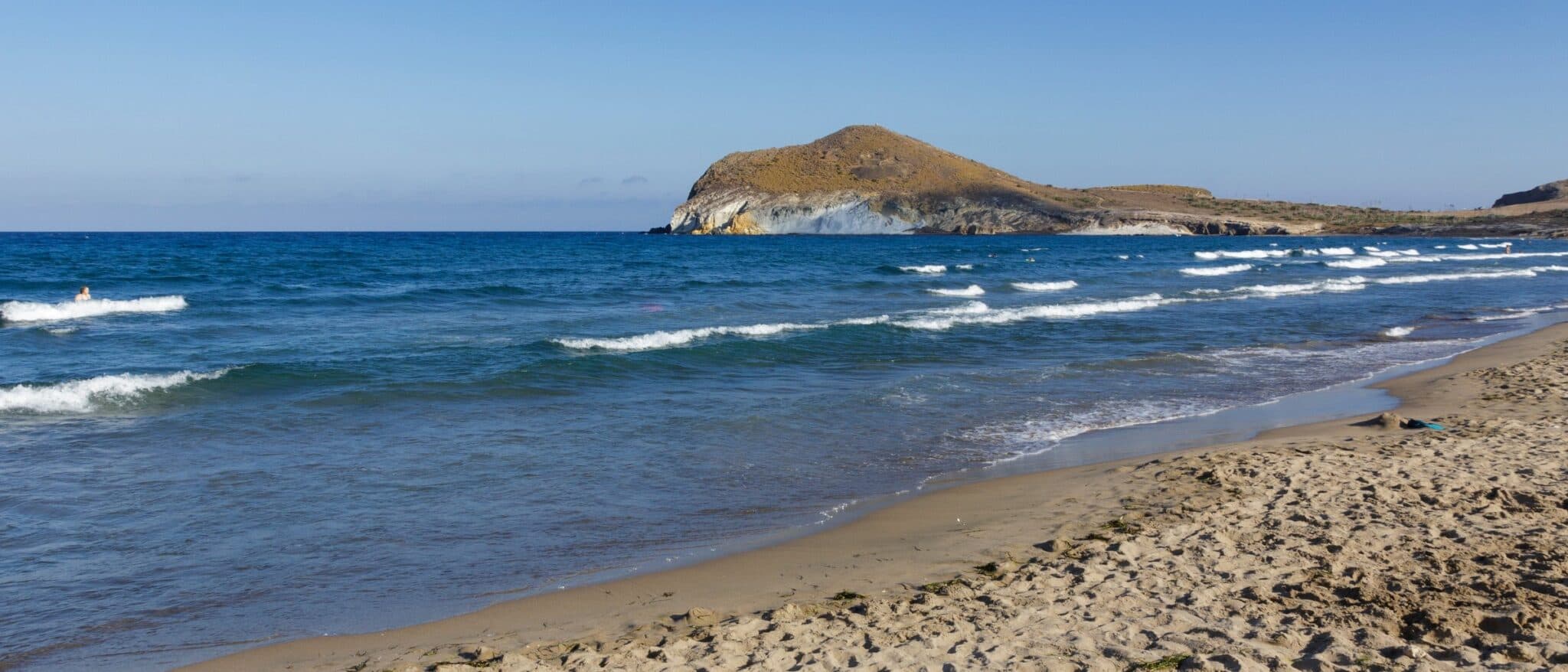
The thing most people get wrong: these beaches have nothing on them. Mónsul is 400 metres of sand with no bar, no tap, no showers, no toilets and no lifeguard, and the car park is 200 metres back from the water. Genoveses is the same, but for the tamarisk and eucalyptus at its northern end — the only natural shade on any of these beaches, and claimed early. Bring two litres of water a head and something to sit under.
The track is compacted piste, fine in an ordinary hire car. San José is roughly 40km from Almería city: the AL-12 airport road, then the N-344 and the AL-3115 at Retamar.
The one thing to do in September
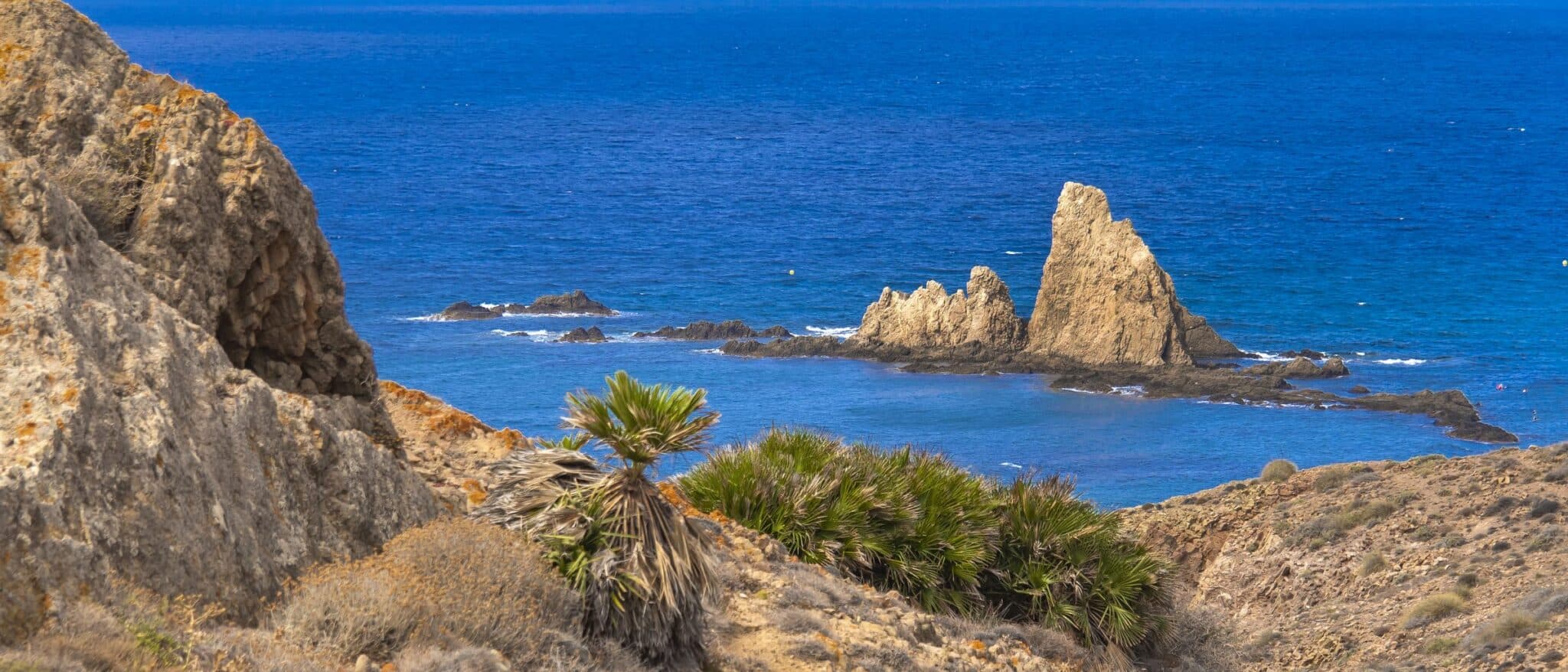
Cabo de Gata in the second half of the month. Mónsul, Genoveses and the Playazo de Rodalquilar are the best beaches in Andalucía and arguably in mainland Spain — volcanic rock, no development, water you can see the bottom of.
In July and August they are capacity-capped, and in 2026 the cap holds until 27 September, not the end of August. What changes in the second half is the pressure behind the rule, not the rule: the shuttle has stopped, the queue has gone, the sea is where it was in August, and the beach you walk onto at 10:00 on a mid-September Tuesday may have twenty people on it. From Monday 28 September the restriction ends and you can drive down as freely as in February, with the water still warm. If you can be here for the last three days of the month, be here.
Common questions
When do the Cabo de Gata car restrictions end in 2026?
27 September 2026 is the last restricted day, so from 28 September you can drive to Genoveses, Mónsul and Cala Carbón without an access control. The Junta de Andalucía set the period in a resolution published in the BOJA on 25 March 2026.
Is the sea warm enough to swim in Almería in September?
Yes — at 22.5–23°C it is the warmest water in Andalucía, and September is its annual peak rather than a decline from it.
Can I reach Mónsul and Genoveses without a car?
Only on foot or by bike after 6 September 2026, when Níjar’s shuttle from San José finished for the season. Walking and cycling in are always permitted — about 3km to Genoveses, 4km to Mónsul — but there is no water or shelter at the far end.