 Travel
Attraction
The Complete Alhambra Visitors Guide (2026)
Everything you need to visit the Alhambra in 2026 — how to book tickets, what to see, how long to spend, and the insider tips that make the difference between a great visit and a chaotic one.
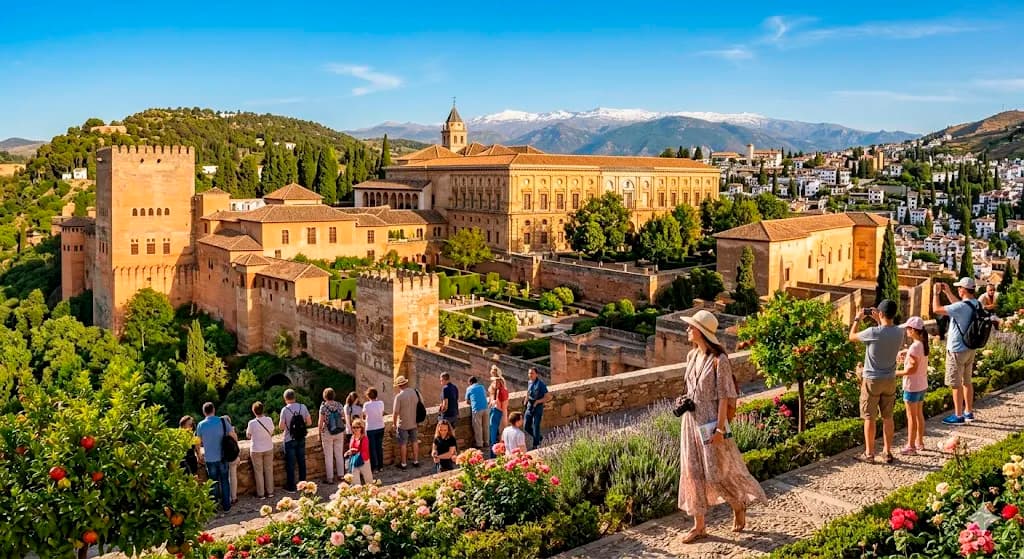
This Alhambra visitors guide covers everything you need to know before you arrive — what to see, in which order, and the small decisions that separate a good visit from an extraordinary one.
Alhambra Visitors Guide: Key Planning Points
The Alhambra is one of those places that exceeds the photographs. The photographs are extraordinary — the reflection pools, the carved stucco, the geometric tile work that seems to breathe and move — and yet standing inside the Nasrid Palaces for the first time, every visitor I’ve ever spoken to says the same thing: it’s more than I expected.
This alhambra visitors guide guide covers everything you need to know for your trip.
Use this alhambra visitors guide resource to plan each stage of your visit to Andalucia.
It’s also one of the most logistically demanding sights in Spain. Tickets sell out months in advance. The entry system is strict (miss your slot by 30 minutes and you don’t get in). The site is large enough that poor planning means seeing half of what you should. This guide fixes all of that.
What is the Alhambra?
The Alhambra is a palace-fortress complex built by the Moorish rulers of the Emirate of Granada between the 13th and 15th centuries, on a forested hill (the Sabika hill) above the city of Granada. It was the final great citadel of Al-Andalus — the Moorish civilisation that dominated southern Spain for 800 years — and its architecture represents the pinnacle of that civilisation’s artistic achievement.
The name comes from the Arabic Al-Ḥamrāʾ — “the red one” — referring to the reddish clay of the walls, which glow gold at sunset.
After the fall of Granada in 1492, the Catholic Monarchs (Ferdinand and Isabella) chose not to demolish the Alhambra — unlike much of Moorish Spain — but to occupy and adapt it. The Emperor Charles V added a Renaissance palace in the 16th century (never completed). The complex fell into disrepair and was nearly destroyed by Napoleon’s troops in 1812, saved only because a Spanish soldier cut the fuses on the explosives. Washington Irving lived in the palace complex in 1829 and wrote Tales of the Alhambra, which brought it to international attention.
Today it receives around 2.7 million visitors per year — more than any other monument in Spain.
The Alhambra: what’s inside
The Nasrid Palaces (Palacios Nazaríes)
The centrepiece and the reason most people come. Three interconnected palaces built by successive Nasrid sultans:
The Mexuar — the oldest and most altered section, originally an audience hall and later converted to a chapel. Atmospheric rather than spectacular; good for understanding the layers of history.
The Comares Palace (Palacio de Comares) — the formal state palace. The Patio de los Arrayanes (Court of the Myrtles) is its heart: a long reflecting pool flanked by myrtle hedges, with the Torre de Comares rising above. The Salón de Comares (Throne Room) has a cedar wood ceiling representing the seven heavens of Islamic cosmology — 8,017 interlocking pieces, no two the same.
The Palace of the Lions (Palacio de los Leones) — the private royal residence, and the most celebrated section of the entire Alhambra. The Patio de los Leones (Court of the Lions) — 124 white marble columns surrounding a fountain supported by 12 stylised stone lions — is the image most people associate with the Alhambra. The surrounding rooms (the Sala de los Abencerrajes, the Sala de las Dos Hermanas) have ceiling muqarnas — stalactite-like honeycomb vaulting — of extraordinary intricacy.
Important: The Nasrid Palaces have a timed-entry window printed on your ticket. This is the one non-negotiable in Alhambra logistics — if you miss your 30-minute entry window, you cannot enter, regardless of what you paid or when you booked.
The Alcazaba
The oldest part of the Alhambra — a military fortress predating the palaces, dating from the 9th century (with major 13th-century additions). The Torre de la Vela is the highest point of the complex, with panoramic views across Granada, the Albaicín, the Generalife gardens, and — on clear days — the Sierra Nevada.
The Alcazaba is included in all standard Alhambra tickets and doesn’t have a separate timed entry. Visit it before or after the Nasrid Palaces.
Time needed: 45 minutes to 1 hour.
The Generalife Gardens (Jardines del Generalife)
The summer palace and gardens of the Nasrid sultans, connected to the main complex by a walkway across the hillside. The Patio de la Acequia (Court of the Long Pond) — a long irrigation channel flanked by jets of water and flowerbeds — is the centrepiece. The upper gardens were redesigned in the 20th century but retain a green, shaded, intensely fragrant atmosphere.
Time needed: 45 minutes to 1 hour. Included in all tickets.
The Palace of Charles V (Palacio de Carlos V)
A Renaissance palace begun in 1527 by the Holy Roman Emperor, dramatically incongruous amid the Moorish architecture — and architecturally significant in its own right. The circular central courtyard (the only circular Renaissance courtyard in existence) is impressive. Houses the Museo de la Alhambra (Nasrid art and artefacts) and the Museo de Bellas Artes de Granada (fine art). Both museums are free with Alhambra entry.
The Partal Gardens and Palace
A lakeside arcade and tower — the oldest surviving palace structure at the Alhambra (early 14th century), often overlooked because it sits between the Nasrid Palaces and the Generalife. Beautifully quiet; the garden pond reflects the Torre de las Damas perfectly.
Worth a 20-minute stop before or after the main Nasrid Palace circuit.
How to book Alhambra tickets
The official booking site
tickets.alhambra-patronato.es — this is the only official source. It charges face value (€19.09 for the General ticket in 2026) plus a booking fee of around €1.50.
Third-party booking sites (GetYourGuide, Viator, etc.) sell the same tickets at a significant markup (often €30–€40+) or as part of guided tours. Unless you specifically want a guide, buy direct.
Ticket types
General (Alhambra General) — €19.09. Includes the Nasrid Palaces, Alcazaba, Generalife, and Partal. This is what most people want. Timed entry to the Nasrid Palaces.
Generalife and Alcazaba only — €10.38. No Nasrid Palaces. Not recommended unless sold out — you’re skipping the main event.
Night visit to the Nasrid Palaces — €8.88. Timed entry to the Nasrid Palaces only, after 8pm. Very atmospheric; no Alcazaba or Generalife. Book separately.
Night visit to the Generalife — €5.93. Gardens only at night with lighting. A pleasant add-on if you’re staying in Granada.
How far in advance to book
- April–June (spring peak): 2–4 months ahead. Easter week and Feria de Abril weeks: 6+ months.
- July–August (summer): 3–6 months ahead. Early morning slots go fastest.
- September–October: 4–8 weeks ahead. October is the easiest.
- November–March: 1–3 weeks; sometimes the same week. January and February often have same-day availability.
What to do if tickets are sold out
- Check at 8am exactly on the day you want to visit — a small allocation of cancelled tickets is released daily at 8am (local time). Set a phone alarm.
- Try a night visit — these sell out more slowly and are genuinely worthwhile.
- Book a guided tour — tour operators often hold a block allocation. Check GetYourGuide or Civitatis; prices are higher but availability is better.
- Visit on a Tuesday or Wednesday — weekdays generally have better availability than weekends.
When to visit the Alhambra
Best time of day
Morning (8.30am–10.30am) is the gold standard. The light in the Nasrid Palaces is most beautiful in the early morning. The courtyards are quietest. The air is cool. If you have a choice, take the earliest possible slot.
Afternoon (2pm–4pm) is the most crowded period — this is when the coach tours arrive. The Nasrid Palaces become noticeably busier, and the photogenic pools and courtyards are packed.
Evening (8pm–10pm, night ticket) — the Nasrid Palaces at night are hauntingly beautiful. The crowds vanish. The muqarnas ceilings are lit dramatically. Book a night ticket even if you visited during the day.
Best time of year
Spring (March–May): The Generalife gardens are in bloom, the Sierra Nevada is still snow-capped, and the light is extraordinary. Trade-off: busiest booking period.
Autumn (October): The best practical window. Crowds are dramatically lower than spring; the Generalife’s roses bloom for the second time; the light is warm and golden; tickets are obtainable within a few weeks.
Winter (November–February): Cold mornings (the marble floors and open courtyards retain the chill), but the complex is at its quietest. The Sierra Nevada’s snow makes the backdrop spectacular.
Summer (July–August): Bearable if you have an early morning slot — the stone stays cool until around 10am. Afternoon visits in summer heat are uncomfortable.
How long to spend
| Visit type | Time needed |
|---|---|
| Nasrid Palaces only (rushed) | 1.5 hours |
| Nasrid Palaces + Alcazaba | 2.5 hours |
| Full complex (all areas) | 3.5–4 hours |
| Full complex + museums | 5+ hours |
My recommendation: Allow 3.5 hours minimum for a satisfying visit. 4 hours if you want to do it properly — Nasrid Palaces, Alcazaba tower climb, Partal pause, Generalife gardens — without feeling rushed.
Getting there
On foot from the city centre
The most atmospheric approach: walk up the Cuesta de Gomérez from the Plaza Nueva, through the Puerta de las Granadas and up the shaded forest path. Takes 20–25 minutes. The walk through the forested hillside — elms, oaks, birdsong — is a pleasant decompression before the palace.
By minibus
The Alhambra Bus (lines C3 and C4) runs from Plaza Nueva every 5–10 minutes, dropping at the ticket offices. Journey: 10 minutes. Cost: €1.40. Useful if you’re short on time or mobility is a concern.
By car
Parking is available at the Alhambra car park (follow signs from the city — the GPS postcode is 18009). €3/hour. Very limited; book a hotel with parking if you’re driving. The ZBE (low-emission zone) restrictions in Granada city centre don’t apply to the Alhambra road.
By taxi
A taxi from central Granada (Puerta Real or Gran Vía) costs €6–€10. The most convenient option if you have luggage or are arriving early.
Insider tips
Set a phone alarm for your entry window. Your Nasrid Palaces ticket has a 30-minute window (e.g., 10:00–10:30am). If you’re in the Alcazaba and lose track of time, you’ll miss it. Set an alarm for 15 minutes before.
Visit the Alcazaba first. Many visitors rush to the Nasrid Palaces first. Go to the Alcazaba on arrival — it opens at the same time, it’s uncrowded, and the Torre de la Vela view gives you the lay of the land before you dive into the palace complex.
Bring water. There are a few fountains inside (the water is safe to drink — the Alhambra’s own spring-fed water system still functions), but no café inside the Nasrid Palaces. Bring a refillable bottle.
Photography: the reflections are best before 10am. The Patio de los Arrayanes pool mirror-reflects the Torre de Comares when the water is still and the morning light comes from the correct angle. By 10.30am, tour groups disturb the surface and the light shifts.
The Sala de los Abencerrajes ceiling. Look up. The muqarnas star vault above the central fountain is considered one of the finest examples of Islamic architecture in existence. Stand beneath it for at least five minutes and let your eyes trace the geometry.
Book the night visit separately if you can. Even if you’ve visited during the day, a night visit to the Nasrid Palaces is a completely different experience. The smaller crowds, the dramatic lighting, and the silence of the courtyard at night are worth the extra €8.88.
Leave time for the Partal. Most visitors rush past the Partal arcade (between the Nasrid Palaces and the Generalife) without stopping. The afternoon light on the torre reflection is exquisite; spend 15 minutes here.
What to eat near the Alhambra
El Huerto de Juan Ranas — garden terrace restaurant with Alhambra views. Expensive but worth it for the view. Dinner reservations essential.
Restaurante Mirador de Morayma — in the Albaicín, looking across to the Alhambra. Traditional Granada cuisine, romantic atmosphere, best at sunset.
Bar Aliatar (lower city, near the Realejo) — Granada’s tapa libre tradition at its best: every drink comes with a free tapa. Order a caña (small beer) and wait to see what arrives.
Mercado San Agustín (near the Cathedral) — covered market with food stalls. Good for lunch if you’re heading to the Alhambra in the afternoon and want to eat first.
Plan your visit
- For the full Granada itinerary around the Alhambra visit: see our 7-Day Andalucia Itinerary
- For when to visit for best ticket availability: see our Best Time to Visit Andalucia guide
- For day trips from Granada combining the Alhambra with other sights: see our Best Day Trips in Andalucia
Useful Resources
For official travel information about Andalucia, visit Alhambra official tickets.
Related reading: how to book Alhambra tickets, Granada travel guide.
Frequently asked questions
Can I visit without booking in advance?
For the Nasrid Palaces: very rarely, and only with same-day luck (the 8am release). For the Alcazaba and Generalife only (no Nasrid Palaces): sometimes possible on the day, particularly in winter. Don’t count on it in spring or summer.
Is the Alhambra worth it?
Yes. Every time. Even if you’ve seen a thousand photos, the physical reality of the Nasrid Palaces — the scale, the detail, the layering of pattern on pattern on pattern — is extraordinary in a way that photographs cannot convey.
How should I dress?
Comfortable walking shoes (you’ll cover 3–5km on uneven stone surfaces). No dress code requirement, but bring a layer — the palace interiors stay cool even when it’s warm outside.
Can children visit the Alhambra?
Yes, and it’s genuinely worthwhile for older children. Under-12s are free. Pushchairs can access most areas, but the forest path approach has steps — take the minibus if mobility is a concern.
Is there an audio guide?
Official audio guides are available to hire at the ticket office (€6). The Alhambra’s official app also has a decent self-guided tour. Many visitors find that a good guidebook (Richard Ford’s 19th-century Handbook for Travellers in Spain is outlandish but wonderful) or simply reading up beforehand is sufficient.
What’s the Parador de Granada?
A luxury hotel inside the Alhambra grounds — converted from a 15th-century convent. Staying here is the ultimate Alhambra experience: you can walk the gardens at dawn and dusk when the day visitors are locked out. Expensive (€350–€500/night), often booked 6+ months ahead. Worth it for a special occasion.