 Blog
BlogTravel
September in Málaga: four ferias, the warmest sea of the year, and the week the crowds go home
The sea is at its annual peak, the Spanish holidaymakers leave over the first weekend, and there is a feria somewhere in the province almost every week of the month.
Málaga province gets the best of September and almost none of the cost. The coast barely cools — 28°C by day at the start of the month, 26°C at the end — and the sea sits at around 22°C, which is warmer than it manages in June. Meanwhile the Spanish holidaymakers who filled every beach in August clear out over the last weekend of the month, and by the first week of September the coast belongs to whoever stayed.
Inland is a different month. Ronda, at 740 metres, runs roughly 24–27°C by day and drops to 12–16°C at night. That is the difference between a beach holiday and a walking one, an hour and a half apart.
What the weather actually does
Málaga airport averages 28.2°C by day and 18.8°C at night in September, with 20mm of rain across just over two rain days and 255 hours of sunshine — the sunniest September figure of the eight Andalusian capitals.
The month slides gently rather than breaking: about 29/21 on the 1st, 26/17 by the 30th. The sea starts near 23°C and finishes around 20.5°C. Compare that to October, when rainfall jumps to 57mm, and September looks like the last dependable month.
Those monthly averages hide two different months. The first ten days are August under another name, heat unbroken. The last ten are one of the best travel windows of the Andalusian year.
September also takes the evenings. The sun sets over Málaga at 20:48 on the 1st and 20:04 on the 30th, 44 minutes of after-dinner light gone. Book a 21:30 table around a view in the last week and you eat in the dark.
One caution. September opens the gota fría season, when cold upper air meets a Mediterranean still at peak warmth. The monthly rainfall total stays low, so this is not a wet month — the risk is a single violent day, and the specific hazard is flash flooding in dry riverbeds. Check AEMET warnings before mountain driving, and never park in a riverbed. See the region’s climate month by month.
Which week to book
If you can take only one week, take the last one. From about the 20th the daytime figure drops to something you can walk a town in, the sea is still around 21°C, and the coast road stops being a queue. The catch is the Torremolinos and Vélez-Málaga ferias, which both land there, so rooms in those two towns are not the bargain the rest of the coast is.
The first ten days are the opposite trade: hottest sea, everything open, three of the four ferias, August prices. A feria week and a quiet week are not the same week.
What is on in September 2026
Four ferias in four weeks, more than any other province manages, plus two harvest fiestas most visitors miss:
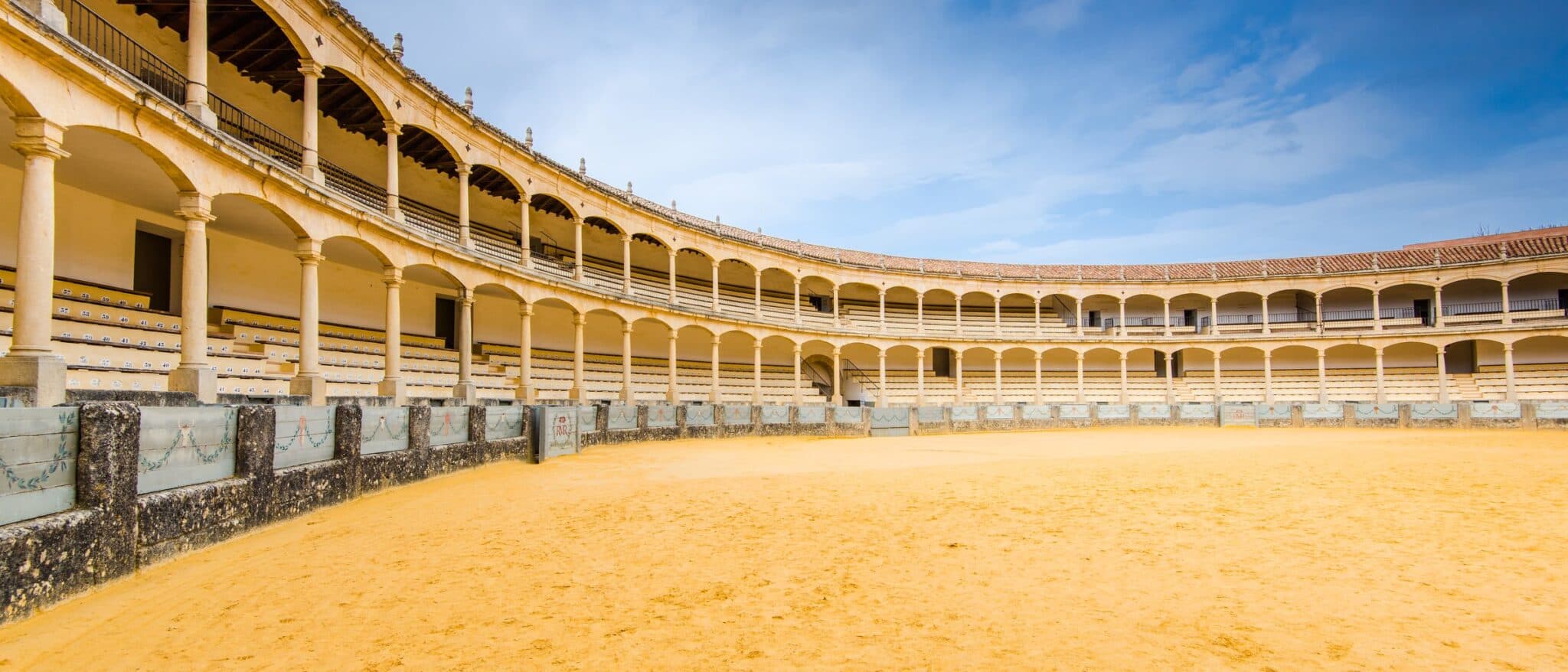
- 1–6 September (confirmed) — Feria de Pedro Romero, Ronda. The Corrida Goyesca is Saturday 5 September at 18:00, the 67th edition, and the bullring reopens after two years of restoration.
- 5–6 September (expected) — Fiesta de la Vendimia, Manilva. The council fixes it to the first weekend of September, the 5th and 6th in 2026, but no programme is out. A public pisa de la uva on Calle Mar makes the season’s first wine.
- 7–12 September (confirmed) — Feria de Mijas. The 8th is the town’s day, for the Virgen de la Peña: feria de día from 13:30 at La Muralla, procession about 21:00.
- 20 September (expected, fixed annually) — Día de la Pasa, El Borge, always the third Sunday. Growers demonstrate the raisin process end to end, in a village that takes 10,000 visitors.
- Around 25–29 September (expected) — Feria de San Miguel, Torremolinos. San Miguel is the 29th and that is fixed; 2024 and 2025 both ran 25–29, but 2026 is not published.
- 29 September – 4 October (confirmed) — Real Feria de San Miguel, Vélez-Málaga. Pregón on the 29th, night feria from the 30th, day feria 1–4 October. Only the opening night falls in September.
The full fiesta calendar has the rest.
What life is like
The turning point is visible and it is the first weekend. Spanish families go home, schools go back on the 10th and 15th, and the coast changes character overnight. Chiringuitos on the main beaches stay open into late October, but the small cove ones start shutting after that first weekend.
Up in the Axarquía, the hillsides are covered in paseros — the sloped drying beds where moscatel grapes are turned into raisins in the sun. It is a September-only landscape and most visitors drive past it without knowing what they are looking at. Mango harvest runs through the coastal strip at the same time.
A pasero is a rectangle of beaten earth or concrete, 10 to 12 metres by 4 to 5.5, tilted south, holding 300 to 400 kg of grapes. The moscatel comes off the vine across August and September and lies out for roughly ten days before the picado, when the dried bunches are trimmed by hand with scissors. Around a thousand growers still do it this way, mostly around Moclinejo, El Borge and Almáchar, on slopes too steep for machinery. The FAO put the system on its Globally Important Agricultural Heritage Systems register in 2017.
The mango harvest overlaps it. Picking starts in late August and peaks through September and October, mostly Osteen, in Spain’s largest subtropical growing area. Roadside stalls between Vélez-Málaga and Nerja sell it riper than any supermarket will.
Coast or inland, and what the drive costs you
Base yourself on the coast and drive inland. Ronda is the trip that costs a real day: from Málaga airport, 109 km and an hour and a half via the AP-7 toll road and the A-397 up from San Pedro, or 98 km and nearer an hour and three quarters free through Cártama and Pizarra. The A-397 is 42 km of mountain road climbing to 1,134 metres over the Puerto del Madroño. Good drive, slow drive; go in daylight.
The Axarquía is a morning. Málaga to Frigiliana is 50 km and 45 minutes, nearly all motorway, and the village sits at 350 metres. Cómpeta down to Torrox Costa is 20 km and half an hour, so the raisin beds are a detour off the beach, not a day out: paseros before lunch, swim after.
The one thing to do in September
The Corrida Goyesca in Ronda on 5 September. Eighteenth-century costume, one of the oldest bullrings in Spain, once a year. The 2026 card is Morante de la Puebla, José María Manzanares and Juan Ortega, with Diego Ventura on horseback. Bullfighting divides people and it is worth saying plainly that this is a bullfight, not a re-enactment.
If that is not for you, drive up into the Axarquía and look at the paseros. The raisin beds are only there in September, and the road through Cómpeta and Frigiliana is worth the morning on its own. Time it for the third Sunday and El Borge does it in public.
Common questions
Is the sea warm enough to swim in September?
Yes, and warmer than most of the summer. The September average at Málaga is 22.2°C against 19.6°C in June and 24°C in August, the second-warmest month of the year in the water.
Early or late September?
Late, unless you want a feria. The last ten days give thinner crowds, softer heat and a sea above 20°C. Early September gives the hottest water and the Ronda, Manilva and Mijas fiestas.
Can Ronda be done as a day trip from the coast?
Yes, but it eats the day. Reckon an hour and a half each way on a mountain road you do not want to rush. During the Feria de Pedro Romero, 1–6 September, parking is a problem and staying over is better.
Where to go next
- The Málaga province guide
- September across Andalucía — how the province compares with the other seven
- Ronda travel guide and the Caminito del Rey
- Costa del Sol beaches
- What to pack